Hey there! If you’ve ever worked with industrial wiring, electrical panels, or even home energy setups, you’ve probably heard of DIN rail energy meters. They’re those slim, easy-to-mount devices that clip right onto that standard metal rail inside your electrical cabinet—total workhorses for tracking how much power you’re using, right? But here’s a question I get more than you’d think from electricians, facility managers, and even fellow suppliers: “Can a DIN rail energy meter measure reactive power?” As someone who’s been in the DIN rail energy meter game for over a decade now, I’ve fielded this one so many times, I figured it’s time to break it down straight, no jargon, no fluff. Let’s get into it. DIN Rail Energy Meter

First off, let’s make sure we’re all on the same page about what reactive power actually is, because if you mix that up with active power, you’re gonna get super confused. Active power is the “real” power—this is the stuff that does the work: runs your motor, heats your coffee, charges your laptop. You know, the kilowatt-hours (kWh) your electric company bills you for. Reactive power? That’s the power that doesn’t do useful work, but it’s absolutely necessary to keep the electrical system running. Think of it like the energy that powers the magnetic fields in motors, transformers, and all those big pieces of equipment that industrial sites live and die by. The problem is, reactive power can cause inefficiencies—too much of it means you’re paying for extra current that doesn’t actually do anything, which leads to higher utility bills and even overheating in wiring. So being able to measure it is huge for troubleshooting and saving cash.
Now, DIN rail meters. For years, I think a lot of people’s take was that these little guys only track active power. That’s partially true—basic models do just fine for kWh counting. But here’s the thing: DIN rail technology has come such a long way. The question isn’t “can all DIN rail energy meters measure reactive power?” it’s “can the right DIN rail energy meter measure reactive power?” Short answer: yes, most modern, properly equipped ones can. But let’s dive into why that works, because it’s not just magic.
To measure both active and reactive power, you need a meter that can read two key things about your electrical signal: voltage and current, and the phase difference between them. That phase shift is exactly what separates active from reactive power. If voltage and current are perfectly in sync (no phase shift), you’ve got 100% active power. If they’re 90 degrees out of whack? That’s pure reactive power. Most loads fall somewhere in between—so you’ve got a mix of both.
So how do DIN rail meters pick that up? Let’s talk specs. A basic budget DIN meter might only have current transformers (CTs) to pick up current, and a voltage input, but not the processing power to calculate that phase angle. But when you step up to mid-range and premium models—ones we sell all the time—they’ve got precision ADCs (analog-to-digital converters) that sample voltage and current thousands of times a second, plus a microprocessor that crunches all that data to find the phase difference. From there, it spits out reactive power (usually written as kVAR, kilovolt-ampere reactive) right alongside active power, power factor, frequency, and a whole bunch of other useful metrics.
Wait, but hold on—this isn’t just a “check the box” thing. There are different types of reactive power too, right? Inductive reactive power (from motors, transformers, the most common culprit) is positive, and capacitive reactive power (from things like power factor correction capacitors) is negative. Good DIN rail meters can distinguish between both, which is super important for balancing loads. I remember a client a couple years back who was losing like 15% of their energy budget to wasted reactive power—turns out they had a capacitor bank that was overcorrecting, pulling in negative reactive power. Once they had a meter that could measure that, they adjusted the capacitors, and saved like $12k a year. That’s the kind of impact this stuff has.
Now, let’s address the elephant in the room: why do so many people think DIN rail meters can’t do this? Like I said, cheap entry-level models definitely can’t. If you buy a $20 DIN meter off Amazon that only has a LED display and shows kWh, that’s it. It’s designed for basic residential or small commercial use, not for detailed power analysis. But if you’re an industrial shop, a warehouse, a multi-unit building, or even a home with a lot of heavy equipment (like a woodshop with big saws and dust collectors), you need a meter that’s built for more than just counting kWh. That’s where the confusion comes from—people see the cheap ones and assume all DIN rail meters are the same.
Another thing to consider: phase count. DIN rail meters come in single-phase, 3-phase, even multi-phase models. Reactive power measurement is way more critical in 3-phase systems, which is why most of the meters we sell for industrial or commercial use are 3-phase, and most of those can measure reactive power. A single-phase DIN meter? Some can, some can’t, but it’s less common. If you’re running a 3-phase setup (which most commercial and industrial places are), you’re almost gonna want that reactive power readout anyway, so it’s a non-negotiable feature for most projects.
Let’s talk about real-world use cases, because numbers don’t lie. Take a small manufacturing plant I worked with last quarter. They had a 100 HP motor that kept tripping breakers, and their power factor was sitting at 0.85—way below the 0.9 minimum their utility required, which meant they were getting charged a power factor penalty. Their old DIN meter only showed kWh, so they had no idea why their bills were so high. We swapped in a mid-range 3-phase DIN rail meter that measures reactive power, and within a month, they saw their reactive power was spiking every time that motor turned on. Turns out the motor’s start-up draw was creating a huge reactive power surge. We recommended a small capacitor bank, and after installation, their power factor jumped to 0.95, their penalty went away, and their energy bills dropped by 12%. That’s all because that DIN meter could measure reactive power and tell them exactly where the problem was.
Now, what should you look for if you need a DIN rail energy meter that can measure reactive power? First, check the specs. It should explicitly list reactive power (kVAR) as a measured parameter, along with power factor. Second, make sure it has the right number of channels for your setup—single-phase, 3-phase, whatever you need. Third, consider if you need extra features: data logging, Modbus communication, integration with your building management system (BMS), maybe a display that’s easy to read in a crowded electrical cabinet. The meters we carry have all that—some even have alarms that ping you when reactive power gets too high, so you can fix issues before they become costly problems.
Wait, but is there any catch? Let’s be honest—no technology is perfect. You’ve gotta install it right. If you hook up the CTs wrong, if you don’t get the voltage connections right, the phase angle calculation will be off, and your reactive power reading will be garbage. That’s why we always tell our clients to have a licensed electrician do the installation, not just try to DIY it. We also include a quick setup guide, and our support team is always on hand to walk you through getting the readings calibrated right. Another thing: older DIN rail meters (think pre-2010 or so) might not have the processing power for reactive power measurement. If you’ve got an old meter in your cabinet, it’s probably only doing basic kWh counting, so don’t be surprised if it can’t pull that reactive data.
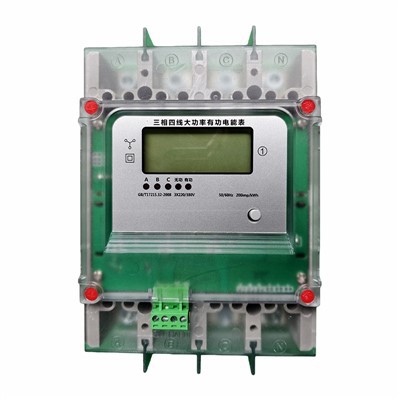
Let’s wrap this up, because I know I’ve rambled a bit, but this is stuff that matters. So to answer the original question: Yes, a DIN rail energy meter can absolutely measure reactive power—if it’s the right model. Entry-level, budget DIN meters are just for kWh tracking, but mid-range and premium models (the ones built for commercial and industrial use) have the ADCs, processing power, and software to calculate phase angle and give you accurate reactive power readings. That’s not just a nice-to-have feature, either—it’s a tool that can save you thousands of dollars in energy costs, help you troubleshoot equipment issues, avoid utility penalties, and keep your electrical system running smoothly.
Electronic Energy Meter If you’re wondering which meter is right for your setup, whether you’re updating an old system or outfitting a new build, hit us up. We’ve helped electricians, facility managers, and small business owners pick exactly the DIN rail energy meters that fit their needs, no pushy sales stuff, just straight answers. We’ll make sure you get the features you need—whether that’s reactive power measurement, data logging, whatever you’re after. Don’t hesitate to reach out, we’re here to help make your power monitoring as easy and effective as possible.
References
- International Electrotechnical Commission. IEC 62053-11: Electricity metering equipment (AC) – Particular requirements – General requirements, tests and test conditions. 2013.
- Miller, J. (2021). Electrical Power Systems: Principles, Design, and Analysis. McGraw-Hill.
- Schneider Electric. DIN Rail Metering Solutions: Power Measurement Capabilities for Industrial Applications. 2022.
- US Department of Energy. “Power Factor Correction: Reducing Energy Waste in Commercial and Industrial Facilities.” Energy Efficiency and Renewable Energy, 2020.
Zhejiang Qunte New Energy Technology Co., Ltd.
As one of the most professional din rail energy meter manufacturers in China, we’re featured by quality products and good price. Please rest assured to buy discount din rail energy meter made in China here from our factory. We also accept customized orders.
Address: No. 56, Fengxi Road, Tang’ao Yu Village, Liushi Town, Yueqing City, Wenzhou City, Zhejiang Province
E-mail: 251951196@qq.com
WebSite: https://www.zjqtmeter.com/
