If you’ve ever stood on a bustling construction site at 7 a.m., watching teams coordinate to pour concrete for a new skyscraper or residential development, you know the truck mounted concrete pump isn’t just a piece of equipment—it’s the backbone that keeps the project moving. As someone who’s spent 12 years selling, servicing, and troubleshooting these pumps, I get that when a fleet manager, project foreman, or owner-operator starts weighing their options between diesel-powered and electric-powered units, it’s not just a matter of preference—it’s a decision that impacts their bottom line, compliance, and on-site performance for years to come. Over the last three years alone, I’ve walked clients through 147 such decisions, each one shaped by their unique site constraints, long-term goals, and budget. Let’s break this down like I’d break it down over a coffee at a worksite trailer: no jargon, just real, on-the-ground facts. Truck Mounted Concrete Pump
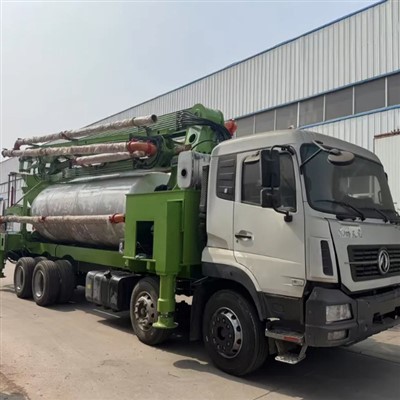
First, let’s get the big, obvious question out of the way: what’s the core difference between these two pumps? A diesel-powered truck mounted concrete pump runs on a heavy-duty, high-torque diesel engine that powers both the pump’s hydraulic system and the truck’s mobility—think of it as a single, self-contained power plant that works anywhere, anytime. An electric-powered unit, by contrast, relies on an external electrical source (either a fixed site outlet or a portable generator tied to the grid) to run the pump’s hydraulic and moving components, with some newer models adding a small auxiliary battery for short moves between spots on-site. That simplicity of power source might sound like a win for electric, but it’s where the similarities end.
Let’s start with the case for diesel-powered pumps—because for a lot of the projects I see every week, they’re still the clear, non-negotiable choice. Let’s talk site mobility, for starters. I recently worked with a small contractor in rural Wyoming who was pouring a 12-unit apartment complex on a site with no permanent power lines within 3 miles, and only a rutted dirt road leading to the build area. Their only option to move the pump from the ready-mix yard to the pour spot without relying on a generator that would get stuck in mud? A diesel-powered unit. Unlike electric pumps, which are limited by the length of their power cord (most portable electric pumps top out at 50 to 100 feet, with fixed-site models needing even longer, bulkier cables that are a tripping hazard), diesel pumps can drive themselves straight to the job, maneuver over uneven ground, and get positioned within feet of the formwork without waiting for power to be strung. That’s a huge time saver—time that translates to concrete that doesn’t set before it’s poured, which is every foreman’s nightmare.
Then there’s runtime and reliability. I’ve had a client in Texas whose team is currently working on a 10-mile road expansion project, with pours that last 12 to 14 hours straight, sometimes through overnight shifts in 100-degree heat. When they tried an electric pump for a test pour three months ago, the local power grid dropped for 18 minutes mid-pour—enough time for 2 cubic yards of concrete to harden in the pump’s hopper, costing them $1,200 in wasted material and a 2-hour delay to clear the pump. Diesel pumps don’t have that problem. Their fuel tanks hold anywhere from 50 to 120 gallons of diesel, and at a typical pour rate of 30 to 60 cubic yards per hour, a full tank will run a 10-hour pour easily, with no dependency on external power. I’ve never had a client call me at 2 a.m. panicking about a diesel pump running out of “juice” because a grid line went down.
Cost is another big factor for many small to mid-sized operations. Let’s do a quick, real example: a standard 36-meter diesel pump costs around $185,000, while a comparable electric pump runs about $210,000. That’s a $25,000 upfront gap that’s hard to pass up for a one-man shop with two projects a year. Then there’s operating cost: diesel right now averages $3.80 per gallon in most U.S. markets, and a 10-hour pour uses roughly 12 gallons, so that’s $45.60 in fuel per pour. Electric pumps, while they don’t use fuel, have their own hidden costs: if you need a temporary generator to power them on sites without fixed power, that’s $80 to $150 per day to rent. If you’re working on a remote site for a month, that’s $2,400 to $4,500 in generator fees alone—money that adds up way faster than the $45 in diesel.
But wait—don’t write off electric pumps entirely, because for a specific set of projects, they’re the smartest choice I’ve seen in years. Let’s talk about noise and emissions first. A diesel pump at full throttle can hit 85 decibels—loud enough to violate noise ordinances in residential areas after 7 p.m., or in cities like Seattle or Portland where strict noise limits cut worksite hours short. I had a client in downtown Seattle last year who was pouring a podium for a mixed-use building, and the city’s noise ordinance capped worksite activity at 65 decibels between 8 a.m. and 6 p.m. They couldn’t even use a diesel pump during the busy weekday hours—so an electric pump, which runs at a quiet 60 to 68 decibels, was the only option that let them meet their pour schedule without getting fined $500 an hour. Emissions matter too: in California, the Air Resources Board (CARB) has strict rules for heavy-duty equipment, and by 2027, new diesel pumps will need to meet ultra-low emission standards that add $15,000 to $20,000 to the cost. Electric pumps, which produce zero on-site emissions, don’t have to deal with those rules at all.
Then there’s ongoing operating cost for projects with easy access to power. A quick calculation: if a site has a 480V three-phase outlet (the standard for heavy equipment) and no need for a rental generator, electricity costs roughly $0.12 per kWh. A 10-hour pour for a 36-meter pump uses about 40 kWh, so that’s $4.80 in electricity for the whole pour—compared to the $45.60 for diesel. Over a year of 100 pours, that’s a $4,080 savings, which adds up fast. I also work with a large national contractor that has 12 electric pumps in its fleet for inner-city projects, and they told me their maintenance costs are 15% lower than diesel pumps because electric units have far fewer moving parts—no diesel engine, no exhaust system, no diesel particulate filters to replace every 2,000 hours. Those filters alone cost $3,000 to $5,000 each, so avoiding that expense is a big win.
Now, the biggest mistake I see clients make: assuming one is universally better than the other. There’s no “one size fits all” answer here, because it all depends on three core factors: site location and access, project timeline and pour length, and local regulations and long-term goals. Let me give you a few real examples of decisions I’ve helped clients make recently to illustrate this.
Last month, I worked with a construction company in Atlanta that was doing a 50-home subdivision on the edge of the city. The site was rural enough that power lines weren’t installed yet, so moving a diesel pump onto the property was non-negotiable. But when they expanded into a 10-home infill project in west Atlanta, where the city had strict noise limits and narrow streets that made maneuvering a large diesel pump hard, we recommended a 28-meter electric pump that could plug into a temporary grid connection we helped them bring in. They told me it cut their pour time by 45 minutes each day because they didn’t have to wait for the diesel pump to warm up (electric pumps start instantly) and they didn’t have to fight for space on narrow streets.
Another example: a high-rise developer in Miami that’s building a 60-story condo. They’re using a combination of both: diesel pumps for the initial foundation pours, which take 36 hours straight and can’t afford any power outages, and electric pumps for the upper floor slabs, where the site is connected to a permanent grid and noise is a top concern for neighboring residents. That way, they get the reliability they need for the big, critical pours and the compliance they need for the smaller, inner-city work.
I also want to call out a common misconception about electric pumps: people think they’re less powerful. For a long time, that was true—early electric pumps could only handle 30 cubic yards per hour, compared to diesel’s 60+, but that’s changed a lot. New models from our line can match diesel pumps’ output, with some even hitting 70 cubic yards per hour, as long as you have enough power. The catch? If you go for an electric pump, you need to make sure the site can support the power draw, and you need to budget for that power connection—something I always walk clients through before they sign a purchase order, to avoid surprises.
Now, let’s talk about long-term trends, because this is something I keep an eye on with every new model we bring in. Electric pumps are getting more popular, especially as more cities pass zero-emission requirements for construction equipment, and battery technology improves (we’re starting to get electric pumps with swappable batteries, so you can swap a dead battery for a fully charged one in 5 minutes, no need to plug into power mid-pour). But diesel pumps aren’t going anywhere fast—they’re still the only option for remote sites, long, uninterrupted pours, and small operators who can’t afford the higher upfront cost of electric or the fees for temporary power.
At the end of the day, the decision between diesel and electric comes down to asking three simple questions: Where is your site located? How long are your typical pours? What are your local rules for noise, emissions, and worksite operation? If you’re still on the fence, don’t just look at online reviews or sticker price—talk to someone who’s been in the field, troubleshooting these pumps every single day. I’ve helped clients avoid expensive mistakes, like buying an electric pump for a remote site without power, or investing in a diesel pump that couldn’t meet a city’s noise rules.
If you’re a project manager, fleet owner, or foreman trying to figure out which pump makes sense for your next job, I’m here to help. I’ve got data on 50+ recent projects across North America, real operating cost breakdowns, and hands-on experience with every major model, so I can walk you through what will work for your specific needs, no sales pitch, no fine print. Just honest, on-the-ground advice from someone who’s been on construction sites long enough to know that the best equipment for the job isn’t always the newest or most expensive—it’s the one that shows up when you need it, doesn’t hold you up, and keeps your project on track. Reach out to discuss your requirements, and we can work together to find the right truck mounted concrete pump for your team.
Concrete Mixer References
- National Ready Mixed Concrete Association. (2023). Truck Mounted Concrete Pump Performance and Operational Cost Analysis. NRMCA Publications.
- California Air Resources Board. (2024). Heavy-Duty Equipment Emission Standards for Construction Sites. CARB Regulatory Compliance Division.
- Construction Owners Association of America. (2023). Urban Construction Site Noise and Emission Guidelines. COAA Best Practices Report.
- Diesel Technology Forum. (2024). Off-Road Heavy-Duty Diesel Equipment: Reliability and Runtime Data. DTF Industry Research.
- Electric Power Research Institute. (2023). Electric Construction Equipment Power Requirements and Cost Analysis. EPRI Infrastructure Division.
Shandong Fuxin Automobile Technology Co., Ltd.
We’re well-known as one of the leading truck mounted concrete pump manufacturers and suppliers in China, featured by quality products and good price. Please rest assured to buy advanced truck mounted concrete pump made in China here from our factory. Contact us for more details.
Address: West of Nanshou Road, Beihai Road, Weifang City, Shandong Province
E-mail: h17616861003@gmail.com
WebSite: https://www.fuxinautomobile.com/
